
The Future of Visual Production: CGI, AI, and What Brands Should Prepare For

Two years ago, “AI video” in a client meeting meant something you showed as a novelty at the end of a deck. Today it’s a line item. That’s a fast shift by any standard, and it’s produced two equally unhelpful positions.
Position one: AI is going to replace production, so budgets should collapse. Position two: AI output looks cheap and clients will never accept it, so nothing really changes.
We run a studio that uses both CGI and AI tools on real client work — FMCG and F&B brands, actual deadlines, actual legal reviews of actual packaging. From that seat, neither position resembles what’s happening. Something more specific and more interesting is going on, and brands that understand it will get better work for their money over the next two years than brands that don’t.
What’s actually changing: the cost of trying things
The biggest shift isn’t in final output quality. It’s in the cost of exploration.
Historically, the expensive part of any visual production was committing. You picked a concept early because testing three concepts properly meant three sets of builds, three shoots, three timelines. So decisions got made from words and mood boards, and everyone hoped the finished thing matched what was in their heads.
That constraint is largely gone. We can now put four fully-realized visual directions in front of a client in a day. Not descriptions, not references from someone else’s campaign — the brand’s own product, in four different lighting moods, four compositions, four color directions.
The knock-on effect is bigger than it sounds. When exploration is cheap, concepts get chosen instead of settled for. And the amount of work that used to disappear into “actually, can we try something completely different?” at week three drops dramatically, because that conversation already happened in week one for the price of an afternoon.
If you’re a brand manager, this is the change that should affect how you brief. Stop arriving with one locked idea you need executed. Arrive with a problem and ask to see options.
What isn’t changing: the things that have to be exactly right
Here’s the part the AI-replaces-everything crowd keeps skipping.
Commercial production has a property that most creative work doesn’t: certain elements cannot be approximately correct. Your packaging artwork is not a stylistic choice. Your logo has a defined lockup. Your product has a shape that legal has approved and manufacturing actually produces. Your brand color is a specific value, and in some categories the claim text on the pack is regulated.
Generative video, as of right now, does not hold those things stable. It will give you a beautiful eight-second shot in which your logo subtly morphs, your label text turns into a lookalike alphabet, and your bottle silhouette drifts by a few percent between the first frame and the last. In a mood film, nobody notices. On a pack shot that’s going out as a brand’s primary asset, everyone notices, and the brand manager notices first.
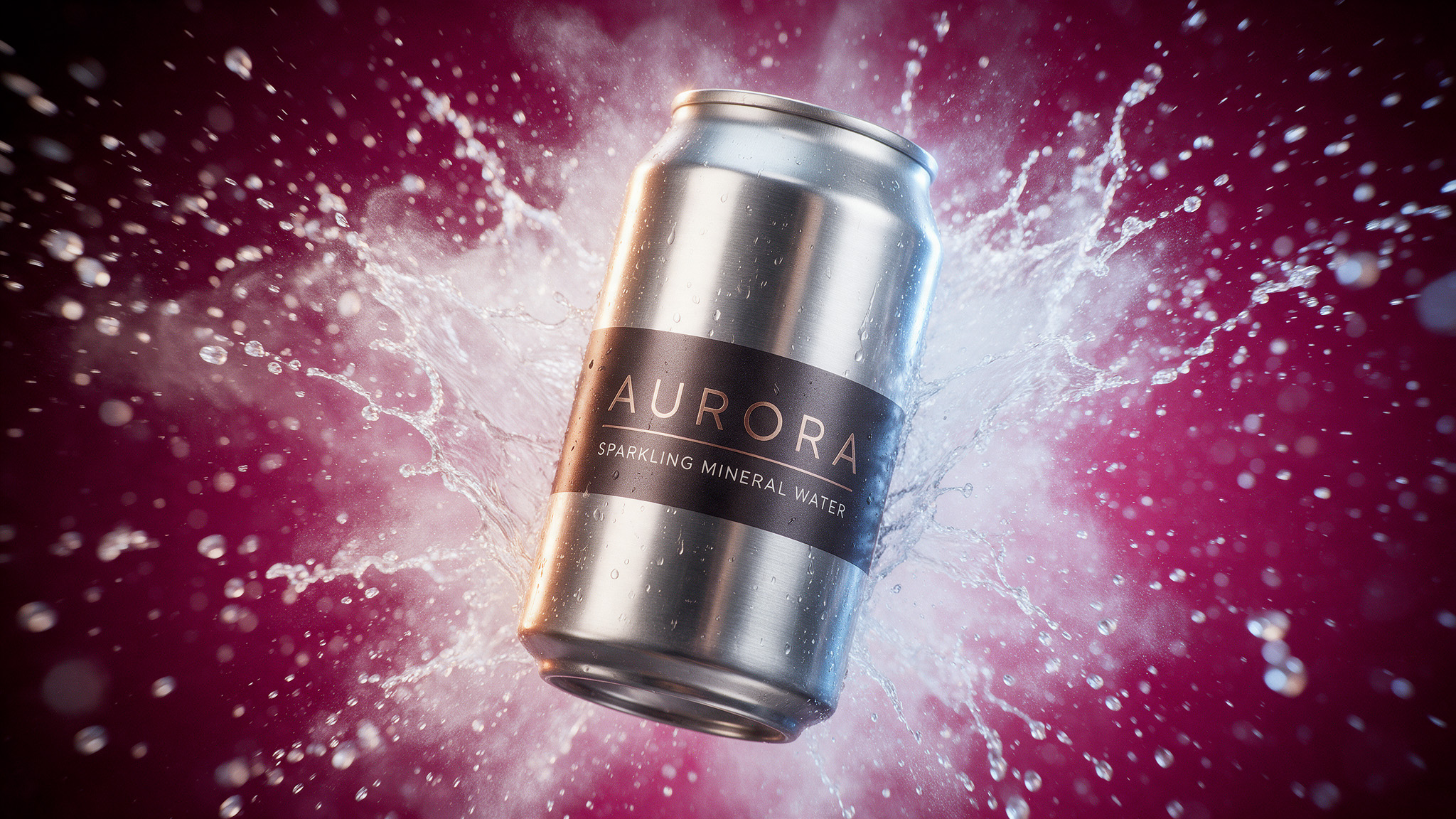
So the boring, correct answer is a split: CGI for anything the brand owns and must control; generative tools for everything around it. Atmosphere, splashes, drifting particles, backgrounds, organic chaos, transitions. That division isn’t a compromise waiting to be resolved by the next model release either — it’s a sensible allocation of two tools with different properties. Deterministic control where you need it, probabilistic abundance where you don’t.
Where I think the next two years actually go
I’ll commit to some predictions, on the understanding that anyone making confident five-year forecasts about this is guessing.
Volume expectations will rise faster than budgets. This is already happening and it’s the shift brands are least prepared for. When a client learns that variations are cheap, the ask stops being “a film” and becomes “a film, six cutdowns, four aspect ratios, three language versions, and a set of statics.” Marginal cost per asset has fallen, but the total volume requested has risen faster. Plan for asset quantity as a distinct line in your brief, not an afterthought at delivery.
Consistency becomes the premium skill. Anyone can generate one good frame. Generating forty shots that look like they came from the same camera, with the same product, across a campaign running for six months — that’s hard, and it’s getting harder as the volume grows. The studios worth paying will be the ones with disciplined asset and reference systems, not the ones with access to the newest model. Access is not a moat. Everyone has the same subscriptions.
Pre-production gets heavier, post gets lighter. More of the decision-making moves to the front of the project, because that’s where it’s now cheap to make decisions. Expect briefing and concept stages to look more substantial, and expect fewer late-stage rescue jobs.
Live-action doesn’t die, but its use narrows. Real human performance, real locations with genuine specificity, anything where the point is documentary truth — those keep their value and arguably gain value as everything else becomes synthesizable. What goes away is the routine tabletop shoot: three days in a studio photographing a pack against seamless backdrop. That job is already mostly CGI in our region and will be entirely CGI soon.
The talk-about-it advantage expires. Right now, a studio saying “we use AI” is a differentiator in Egypt and the GCC. Within eighteen months it’s table stakes, the way “we work in 4K” stopped being a selling point. What will differentiate is craft judgment: knowing which tool to use for which shot, and knowing when the output isn’t good enough to send.
What brands should actually do about it
Four practical things, none of which require a new budget line.
Get your brand assets into a usable state. This is unglamorous and it’s the highest-return thing on the list. Print-ready packaging artwork with dielines, an up-to-date brand guideline with real color values, clean logo files, and — if you have them — 3D product models from a previous project. Studios that have this can move in days. Studios waiting on a JPEG from someone’s inbox lose a week before starting.
Ask studios what’s CGI and what’s generated, and expect a straight answer. Not because one is better, but because it tells you what’s controllable in revisions and what isn’t. A studio that can’t or won’t explain the division is either hiding something or hasn’t thought about it.
Stop benchmarking budget against last year’s shoot. The comparison isn’t useful anymore, in either direction. What a production budget buys has changed shape: fewer days of physical logistics, more days of craft time and more deliverables out the other end. Brief on outcomes and asset lists, then talk cost.
Re-use rather than re-commission. Once a product exists as a proper 3D asset, the second campaign is meaningfully cheaper than the first — new lighting, new environment, new motion, same geometry and materials. Brands that treat their 3D assets as a library instead of a one-off project deliverable compound that advantage every cycle. Ask for the assets, and ask what the terms are.
The part that doesn’t change
All of this is tooling. The reason one product film sells and another doesn’t has never been resolution, render engine, or model version. It’s whether the thing looks appetizing, whether the pack is instantly recognizable on a phone screen, and whether someone made a clear decision about what the viewer should feel in the first second.
Those are craft and judgment questions, and no tool has offered to answer them yet. The studios that keep taking them seriously will be fine. The ones treating AI as a way to produce more, faster, without deciding anything will produce an enormous volume of work nobody remembers.
That’s the actual opportunity in the next two years, and it’s oddly old-fashioned: the cost of making things has dropped, so the value of taste has gone up.
